BlockViz
GuidesPriceIndexed Performance Comparison

Indexed Performance Comparison

How to compare the normalized performance of two crypto assets over time.

Open tool →

Interpretation

What problem this visualization solves

Comparing crypto assets by price alone is misleading.

Bitcoin at $90,000 and Ethereum at $3,000 tells you nothing about which asset performed better, how much risk was taken, or when leadership changed. Percentage returns are harder to track visually across assets, especially over longer periods.

Indexed Performance Comparison removes price-level bias so relative performance can be evaluated directly.

What you’re looking at
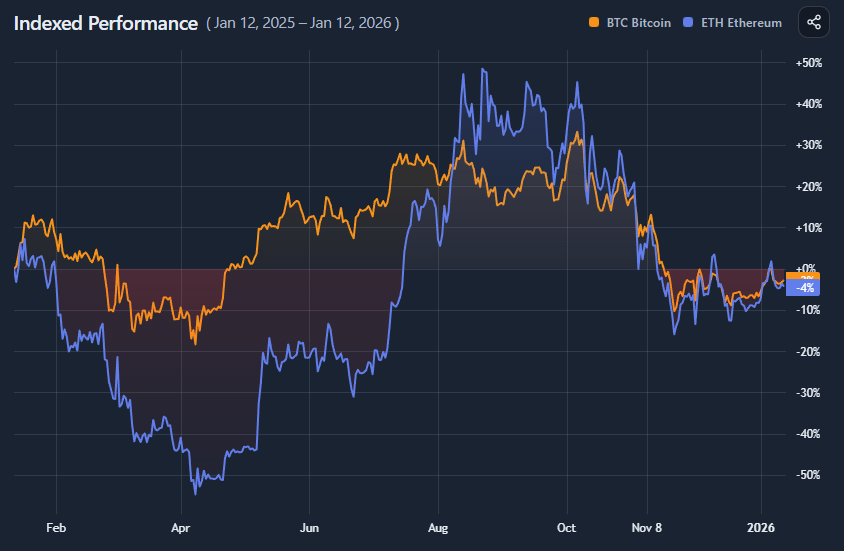
Each selected asset is converted into an index that starts at 100 on the chosen start date.

  • The vertical axis represents percentage change relative to the start
  • A value above 100 means the asset is up since the start date
  • A value below 100 means it is down

Because all assets share the same starting point, their performance paths can be compared directly.

How the index is constructed

For each asset:

  • The price on the selected start date is set to 100
  • All subsequent values are scaled proportionally
    (current price ÷ start price × 100)
  • Calculations use daily closing price data

This removes absolute price differences and isolates relative performance over time.

How to read common patterns

Sustained divergence

If one line steadily moves above another, that asset has consistently outperformed during the period. This often reflects stronger demand, narrative leadership, or lower drawdown pressure.

Drawdown depth

Sharper and deeper declines indicate higher downside volatility. Two assets can finish near the same level while offering very different risk experiences along the way.

Leadership rotation

When indexed lines cross, leadership has changed. These crossings often occur around regime shifts, macro events, or sector rotations.

Same return, different path

Assets can end with similar final returns while experiencing very different drawdowns, recovery speeds, and volatility. Indexed charts reveal these differences clearly.

Common misinterpretations (important)

  • Indexed performance is not risk-adjusted performance
    Higher returns may come with deeper drawdowns.
  • Short-term leadership does not imply long-term superiority
    Outperformance can reverse quickly depending on the start date.
  • A flat index does not mean low volatility
    Large swings can cancel out over time.

Indexed comparison helps understand relative paths, not predict future prices.

When this visualization is most useful

  • Comparing BTC vs ETH or major L1s across market phases
  • Studying leadership during bull and bear markets
  • Evaluating drawdowns versus recoveries
  • Understanding rotation between assets over time

When not to use it

  • For absolute price targets
  • For intraday or very short-term trading
  • For illiquid assets with sparse pricing data

Key takeaways

  • Indexed charts remove price-level bias
  • Relative performance becomes immediately comparable
  • The path matters as much as the final return
  • Leadership changes more often than headlines suggest

How to use

Controls and options

You can use the Indexed Performance Comparison tool to:

  • Select up to two assets to compare
  • Adjust the start and end dates
  • Change the time window to study different market regimes
  • Share the chart state for discussion or documentation

Changing the start date can significantly alter the interpretation, so it should be chosen intentionally.

Performance Highlights panel

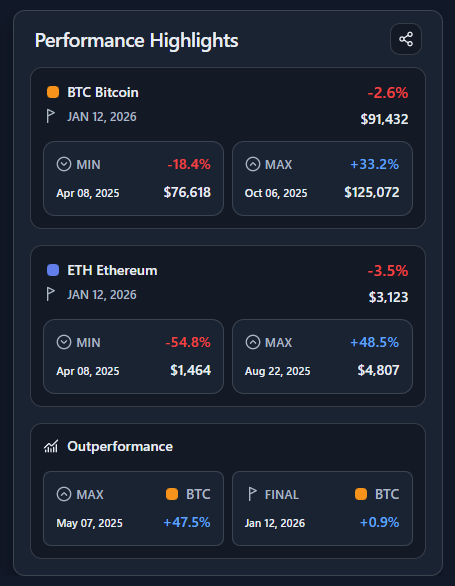
The Performance Highlights panel summarizes key outcomes numerically:

  • Final performance
    Where each asset ended relative to the starting index
  • Minimum and maximum
    • Deepest drawdown (with date and price)
    • Maximum gain achieved during the period
  • Outperformance
    • The largest performance spread between assets
    • Which asset finished ahead at the end date

This panel answers:

“Who won, how painful was the journey, and when did it matter most?”
Example workflow

A simple way to use the visualization:

  1. Select two assets (e.g. BTC and ETH)
  2. Choose a meaningful start date (cycle low, market top, or regime shift)
  3. Observe:
    • Relative drawdowns
    • Leadership changes
    • Final performance
  4. Adjust the start date to see how conclusions change

This helps reveal how timing and path dependency influence perceived performance.

Indexed Performance Comparison preview

Try it yourself

Indexed Performance Comparison

Use the interactive tool to explore the same concept with your own time range and settings.