BlockViz
WikiReturns & RiskRelative Performance

Relative Performance

Category: Returns & Risk

Markets are not just about going up or down — they are about doing better or worse than something else.

Relative performance measures how an asset, portfolio, or strategy performs compared to a reference, rather than in isolation. It is one of the most important — and most misunderstood — concepts in investing.

This article explains what relative performance is, how it differs from absolute performance, and why it matters so much in crypto.

What relative performance means

Relative performance answers the question:

“Did this outperform something else?”

That “something else” could be:

  • another asset (e.g. ETH vs BTC)
  • a basket (e.g. altcoins vs total market)
  • a portfolio benchmark
  • a base currency (e.g. BTC-denominated returns)

Relative performance is always comparative.

Absolute performance vs relative performance

Absolute performance

Absolute performance looks at standalone returns.

Examples:

  • BTC is up +20%
  • A portfolio is worth $100,000
  • An asset gained $5,000 in value

This answers:

“Did I make or lose money?”

Relative performance

Relative performance compares outcomes.

Examples:

  • ETH outperformed BTC by +15%
  • This portfolio lagged the market
  • Switching assets increased BTC holdings

This answers:

“Was this the better choice?”

Why absolute gains can still mean underperformance

You can make money and still underperform.

Example:

  • BTC: +30%
  • ETH: +60%

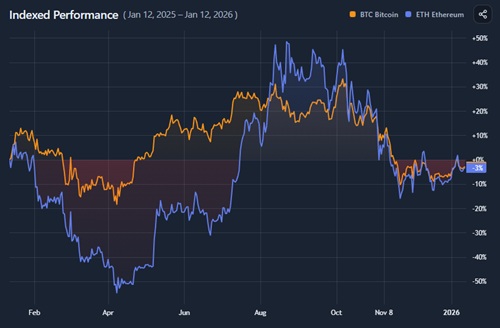
Both gained — but ETH outperformed BTC.

If you held BTC instead of ETH, you:
  • made money
  • but gave up relative gains

This opportunity cost is invisible in absolute returns alone.

Relative performance as opportunity cost

Relative performance is best understood as opportunity cost.

Every position implicitly asks:

  • Why this asset instead of another?
  • Why hold instead of switch?
  • Why allocate here rather than there?

Relative analysis makes those trade-offs explicit.

Relative performance in crypto markets

Crypto is especially sensitive to relative performance because:

  • assets move in cycles
  • leadership rotates frequently
  • BTC, ETH, and altcoins take turns outperforming
  • many investors think in base-coin terms (BTC, ETH)

This makes relative frameworks essential for:

  • rotation analysis
  • dominance tracking
  • portfolio construction
  • strategy comparison

Common ways to measure relative performance

Indexed comparisons

Normalize assets to the same starting point (e.g. 100) to compare trajectories instead of prices.

Useful for:

  • leadership shifts
  • drawdowns
  • sustained outperformance

Base-coin denomination

Measure performance in BTC or ETH instead of USD.

Useful for:

  • long-term holders
  • “stacking sats” logic
  • avoiding fiat bias

Dominance and market share

Track how much of a reference market an asset controls.

Useful for:

  • structural strength
  • rotation detection
  • market regime analysis

Portfolio-relative views

Compare assets within a portfolio or against a benchmark.

Useful for:

  • allocation drift
  • concentration risk
  • performance attribution

Relative performance vs timing

Relative performance does not imply timing skill.

It does not say:

  • you could have predicted the winner
  • you should constantly rotate

It shows:

  • what would have been better in hindsight
  • how sensitive outcomes are to allocation choices

Understanding relative outcomes improves intuition — not prediction.

Common misconceptions

“Relative performance only matters if I switch”

False.

Even buy-and-hold investors experience relative outcomes because:

  • capital is finite
  • holding one asset means not holding another

“If everything is up, relative doesn’t matter”

False.

Relative differences compound over time and dominate long-term results.

“Relative performance is only for traders”

False.

Long-term investors, allocators, and portfolio builders rely on relative analysis to understand structural shifts.

When relative performance matters most

Relative performance is most useful when:

  • comparing assets or strategies
  • analyzing rotations
  • evaluating portfolios
  • thinking in non-fiat terms
  • assessing opportunity cost

When absolute performance is enough

Absolute performance is sufficient when:

  • measuring profit/loss
  • managing risk limits
  • evaluating personal outcomes
  • handling cash flows

Key takeaway

Absolute performance answers:

“Did I make money?”

Relative performance answers:

“Was this the best use of my capital?”

In crypto — where cycles, rotations, and opportunity costs dominate — relative performance is often the more important question.

Understanding both perspectives is essential to understanding markets at all.

Indexed Performance Comparison preview

Related Tool

Indexed Performance Comparison

Use the interactive tool to explore the same concept with your own time range and settings.