BlockViz
WikiReturns & RiskMarket Rotation

Market Rotation

Category: Returns & Risk

Markets don’t move uniformly.
Capital rotates.

Rotation describes the process by which capital flows from one asset, sector, or theme into another over time. In crypto, rotation is one of the dominant forces shaping market structure, relative performance, and so-called “alt seasons.”

This article explains what rotation is, why it happens, and how to interpret it without turning it into a timing myth.

What rotation means

Rotation is the reallocation of capital across assets or categories.

Instead of the entire market moving together:

  • some assets gain share
  • others lose share
  • leadership changes over time

Rotation is visible in relative performance, not just prices.

Rotation vs market direction

Rotation is orthogonal to market direction.

You can have:

  • a rising market with rotation
  • a falling market with rotation
  • a flat market with strong internal rotation

Example:

  • Total market cap is flat
  • Bitcoin dominance falls
  • Altcoin categories gain share

Prices alone may look quiet — structure is not.

Why rotation happens in crypto

Rotation in crypto is driven by several structural forces:

Capital size and liquidity

Large assets absorb capital first.
Smaller assets respond later with higher beta.

Risk appetite cycles

As risk appetite increases:

  • capital moves from “safer” large caps
  • into higher volatility segments

As risk appetite contracts:

  • capital flows back to perceived safety

Narrative and sector cycles

Capital often clusters around:
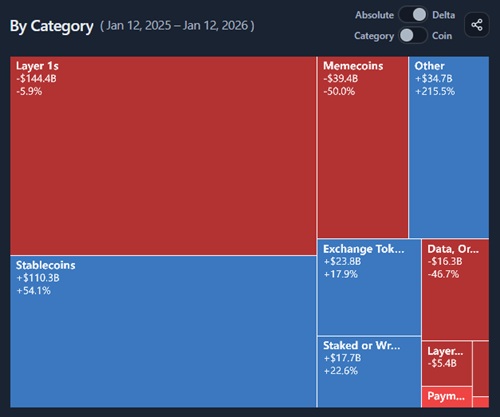
  • Layer 1s
  • DeFi
  • Memecoins
  • AI / infra themes

Rotation follows narratives — until it doesn’t.

Relative valuation and exhaustion

After sustained outperformance:

  • leaders become crowded
  • marginal upside shrinks
  • capital seeks alternatives

Rotation is often a pressure release, not a signal.

Asset rotation vs sector rotation

Asset rotation

Capital moves between individual assets.
Example:

  • BTC → ETH
  • ETH → SOL

This is often driven by relative momentum.

Sector rotation

Capital moves between categories.
Example:

  • Layer 1s → Memecoins
  • Infrastructure → Applications

Sector rotation reshapes market structure more broadly.

Bitcoin dominance and rotation

Bitcoin dominance is one of the cleanest rotation indicators.

  • Rising BTC dominance → capital concentrating
  • Falling BTC dominance → capital dispersing

Importantly:

  • falling dominance does not require BTC to fall
  • it only requires others to grow faster

This is why dominance is a relative measure, not a price signal.

Alt season as a rotation phase

“Alt season” is not a single event.
It is a rotation phase.

Characteristics:

  • BTC leadership weakens
  • categories outperform sequentially
  • volatility increases
  • dispersion widens

Rotation during alt seasons is uneven and fragile.

Rotation is observable, not predictable

Rotation is easy to identify after it happens.
It is hard to time before it happens.

Most rotation tools answer:

  • where capital flowed
  • who gained or lost share
  • how leadership changed

They do not predict:

  • when rotation will start
  • how long it will last
  • which asset is “next”

Common misconceptions

“Rotation means sell winners, buy losers”

False.

Rotation often rewards relative strength, not mean reversion.

“Alt season means everything pumps”

False.

Rotation creates dispersion:

  • some assets massively outperform
  • many underperform or stagnate

“Rotation is a trading signal”

Not necessarily.

Rotation is a structural lens, not a timing trigger.

How to analyze rotation properly

Rotation is best studied through:

  • relative performance
  • dominance changes
  • category-level views
  • share-of-market analysis

It becomes misleading when reduced to:

  • single indicators
  • fixed thresholds
  • narrative-driven assumptions

When rotation analysis is most useful

Rotation analysis is most useful when:

  • comparing assets or sectors
  • understanding regime shifts
  • explaining relative outcomes
  • managing portfolio concentration
  • contextualizing performance

When rotation analysis is misleading

Rotation analysis breaks down when:

  • used as a short-term signal
  • forced into deterministic rules
  • ignored in favor of price-only views
  • disconnected from liquidity context

Key takeaway

Rotation is not about predicting the next winner.

It is about understanding where capital moved, where it concentrated, and where it lost conviction.

In crypto — a market defined by relative cycles — rotation is not a side effect.
It is the market.

Market Cap Treemap preview

Related Tool

Market Cap Treemap

Use the interactive tool to explore the same concept with your own time range and settings.

Market Rotation – BlockViz Wiki