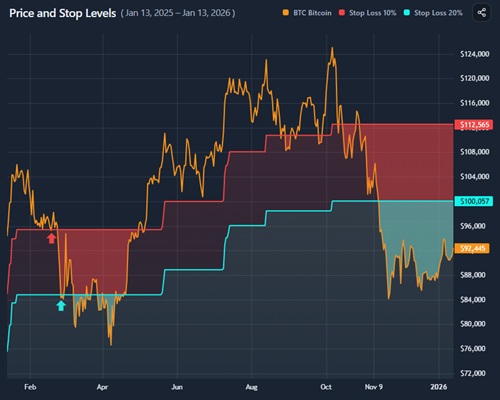
Drawdown measures how much an asset, portfolio, or strategy falls from its previous peak.
It answers a question that price and returns alone cannot:
How painful was the worst decline along the way?
In volatile markets like crypto, drawdowns often matter more than final returns.
What drawdown represents
A drawdown is the decline from a local peak to a subsequent trough, measured before a new peak is reached.
It is usually expressed as a percentage.
Example:
- Peak value: $100
- Trough value: $60
→ Drawdown: −40%
Drawdowns describe path risk, not end results.
Maximum drawdown explained
Maximum drawdown is the largest peak-to-trough decline over a given period.
It represents:
- the worst loss an investor would have experienced
- the maximum psychological and capital stress point
- the deepest hole that had to be recovered from
Maximum drawdown ignores how fast recovery happened — only depth matters.
Drawdown vs volatility
Drawdown and volatility are related but different.
- Volatility measures how much prices fluctuate
- Drawdown measures how bad the worst decline was
An asset can:
- have high volatility but shallow drawdowns
- have low volatility but one severe drawdown
Drawdown captures tail pain, not noise.
Why drawdowns matter more than returns
Large drawdowns create structural problems:
- they require disproportionately larger gains to recover
- they increase emotional pressure and decision errors
- they raise the risk of selling at the worst possible time
A −50% drawdown requires a +100% gain just to break even.
Drawdown asymmetry and recovery math
Losses and gains are asymmetric.
| Drawdown | Gain required to recover |
|---|---|
| -10% | +11% |
| -25% | +33% |
| -50% | +100% |
| -75% | +300% |
This asymmetry is why drawdown control matters even for long-term investors.
Drawdowns in crypto markets
Crypto assets routinely experience:
- drawdowns of 50–80%
- multi-year recovery periods
- repeated deep declines even in secular bull markets
This makes drawdown awareness essential when:
- comparing assets
- evaluating strategies
- sizing positions
- deciding on leverage or stops
Drawdown vs risk management tools
Different tools interact with drawdowns differently:
- Stop losses can cap drawdowns but increase exit frequency
- DCA can reduce timing risk but not eliminate drawdowns
- Trimming can reduce drawdown depth at the cost of upside
- Diversification can smooth drawdowns but not remove them
No tool removes drawdowns entirely — they only reshape them.
Common misconceptions
“Maximum drawdown tells me future risk”
False.
It only describes historical worst-case, not future guarantees.
“Lower drawdown means better strategy”
Not always.
Lower drawdown often comes with:
- lower upside
- lower participation
- different risk trade-offs
“I can ignore drawdowns if I hold long enough”
Psychologically and structurally dangerous.
Most investors abandon strategies during drawdowns, not at peaks.
When drawdown analysis is most useful
Drawdown analysis is most useful when:
- comparing strategies or assets
- evaluating risk tolerance
- stress-testing assumptions
- deciding position sizing
- understanding path dependency
When drawdown analysis is misleading
Drawdown analysis breaks down when:
- used without return context
- treated as a single decision metric
- ignored in favor of peak-to-peak charts
- applied without understanding volatility regimes
Key takeaway
Drawdown measures how deep the pain went, not how good the ending looks.
- Returns tell you where you finished
- Drawdowns tell you whether you could survive the journey
- In crypto, drawdowns are structural — not anomalies
Understanding drawdown is a prerequisite for understanding risk.