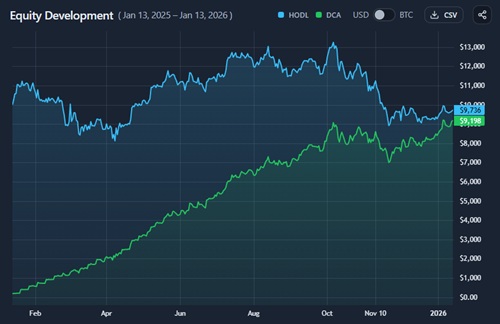
Volatility describes how much and how fast prices move.
In crypto, volatility is not a side effect — it is a defining feature. Understanding volatility is essential for interpreting returns, managing risk, and avoiding false conclusions about strategy performance.
This article explains what volatility is, how it behaves in crypto, and why it matters far beyond short-term price swings.
What volatility represents
Volatility measures the dispersion of returns over time.
High volatility means:
- large price swings
- frequent sharp moves
- unstable short-term outcomes
Low volatility means:
- smaller price changes
- smoother price paths
- more predictable short-term behavior
Volatility is about movement, not direction.
Volatility vs trend
Trend and volatility are independent.
You can have:
- a strong uptrend with low volatility
- a strong uptrend with high volatility
- a sideways market with extreme volatility
Trend answers where price is going.
Volatility answers how violently it gets there.
Why crypto volatility is structurally high
Crypto volatility is driven by structural factors:
- fragmented liquidity
- leverage and derivatives
- reflexive narratives
- rapid sentiment shifts
- immature market depth
These forces amplify both upside and downside moves.
Volatility regimes
Volatility is not constant. It clusters.
Markets move through volatility regimes:
- Low-volatility regimes
Compression, range-bound price action, complacency - High-volatility regimes
Breakouts, crashes, liquidation cascades, regime shifts
Transitions between regimes often matter more than the regimes themselves.
Volatility clustering
Large moves tend to follow large moves.
This is why:
- calm periods often precede explosive breakouts
- high volatility persists longer than expected
- stops cluster and trigger sequentially
Volatility is path-dependent.
Volatility and return concentration
High volatility concentrates returns.
In volatile markets:
- a small number of days drive most returns
- missing those days drastically alters outcomes
- timing risk dominates intuition
This is why “best days” and “worst days” matter disproportionately.
Volatility vs risk
Volatility is often used as a proxy for risk — but they are not the same.
- Volatility measures variability
- Risk measures unwanted outcomes
High volatility can be:
- opportunity (for traders)
- danger (for leveraged positions)
- neutral (for long-term holders with conviction)
Context determines whether volatility is harmful or beneficial.
Volatility and strategy outcomes
Volatility interacts differently with strategies:
- Stop losses
High volatility increases stop-outs, not necessarily bad trades - DCA
Volatility improves average entry prices but increases path noise - Buy & hold
Volatility tests conviction more than thesis - Rotation strategies
Volatility accelerates leadership changes
Strategies don’t remove volatility — they redistribute its effects.
Common misconceptions
“Lower volatility is always better”
False.
Lower volatility often comes with:
- lower upside
- slower compounding
- reduced participation in breakouts
“Volatility means uncertainty”
Partially true, but incomplete.
Volatility reflects movement, not ignorance.
Markets can be volatile and efficient at the same time.
“Volatility can be ignored long-term”
Psychologically dangerous.
Volatility drives drawdowns, exits, and regret — even for long-term investors.
When volatility analysis is most useful
Volatility analysis is most useful when:
- choosing position sizes
- setting stop losses
- interpreting drawdowns
- comparing strategies
- understanding return concentration
When volatility analysis misleads
Volatility analysis breaks down when:
- treated as a standalone risk metric
- ignored during regime changes
- smoothed away by long averages
- detached from market structure
Key takeaway
Volatility defines the path, not the destination.
- It magnifies gains and losses
- It clusters and changes regimes
- It reshapes strategy outcomes
- It tests behavior more than logic
In crypto, understanding volatility is not optional — it is foundational.