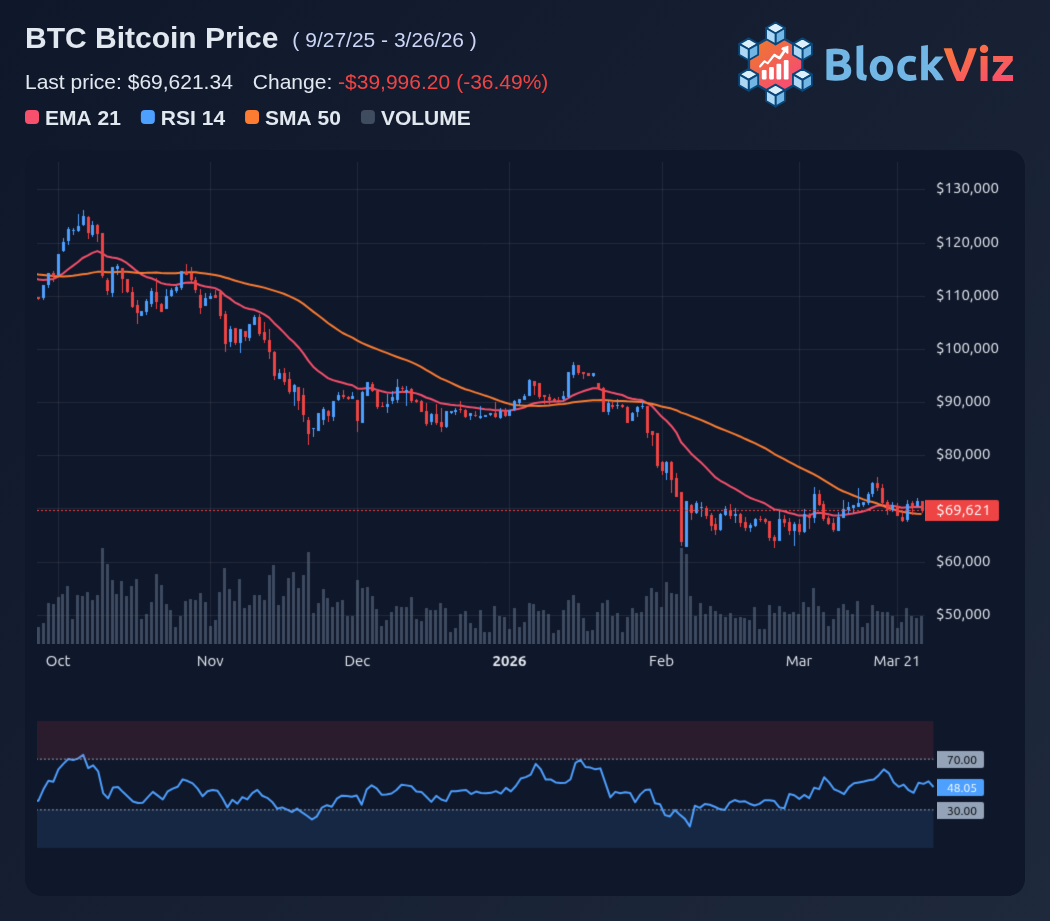

Nearly $14B worth of BTC options expiring into a $75K max pain scenario is precisely the kind of setup that could influence price into a narrow range before a clear direction emerges. The bulk of open interest is clustered around $73K-75K and $75K calls, making dealers and option writers most comfortable if spot price hovers as close as possible to that $75K area into the March 27 triple expiry.
When such a significant notional amount is tied to a single price band, the market often behaves as if it's trading around a gravitational pull. As BTC moves below $75K, dealers who are short calls tend to buy into dips and sell into spikes to maintain their hedges. This mechanically guides price toward the max pain area where their books are most balanced. This explains why $75K can start acting less like traditional resistance and more like a magnet, especially as settlement time approaches and hedging activity intensifies.
Adding to this tension, this options expiry also releases a lot of "compressed" positioning. Approximately 41% of BTC options open interest is tied to this expiry alone, with a disproportionate amount in $75K calls. Once these contracts expire, dealers can unwind hedges, and discretionary traders can reposition into fresh strikes for Q2. This transition often precedes notable market movements, which could be a rejection from the magnet level if new shorts emerge, or an upward squeeze if spot ultimately clears $75K and compels late bears to cover.
Leading into this expiry, key observations for market participants include: how tightly BTC trades around the $73K-75K range, whether options flow shifts from short calls to more aggressive upside hedging, and if post-expiry spot suddenly becomes easier to push away from $75K instead of being continuously pulled back to it. If $75K ceases to act as a magnet and instead functions as a floor on a subsequent retest, it would suggest a change in how the derivatives market influences price movements.