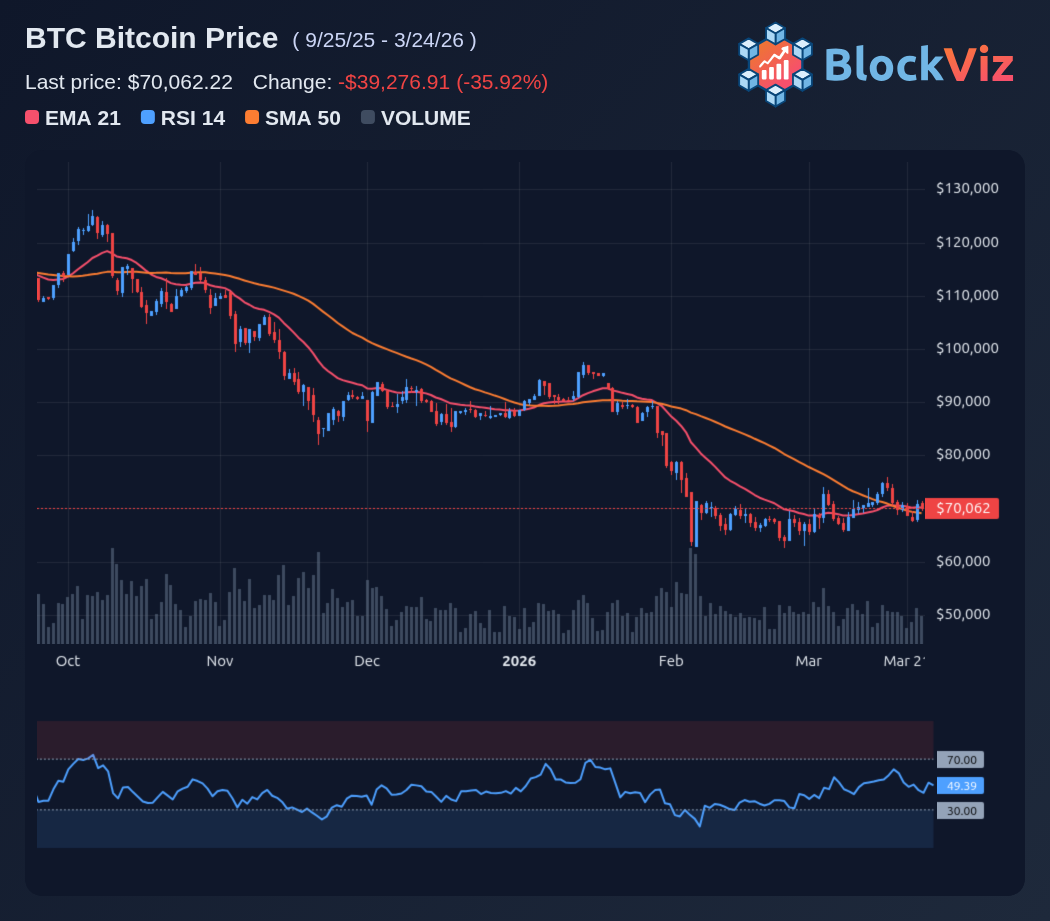

Key metrics are lining up around 60K as a structural floor, but that does not mean 75K is some easy post‑breakout highway. The market has already tried to clear that band several times, and each lift has stalled just under or around 72K–75K, leaving a clear ceiling rather than a doorway. Right now, the real story is not whether 60K holds, but whether the next rally can generate enough conviction to rupture that upper zone and flip it from resistance into support.
Below 65K, on‑chain data and order‑book heat maps still show persistent demand clusters, which is why 60K–62K keeps acting like a magnet instead of a free‑fall zone. Open interest has cooled, funding rates have stayed neutral‑to‑slightly negative, and spot‑flow indicators are no longer screaming capitulation. That fits the classic “compression before a move” environment, where the market burns out the last sellers and early buyers but hasn’t yet built the momentum needed to rip through a tight range.
For 75K to actually break, traders need to see three things in tandem: a clean daily close above 75K with strong volume, a clear expansion of open interest on the long side, and a meaningful reduction in liquidation walls stacked just above that level. Until that happens, the 60K–75K box is more like a mean‑reversion trading zone than a springboard. Range‑traders can play the inner bands, but the directional breakout will only announce itself when price stops respecting that upper ceiling and instead starts anchoring new lows and pullbacks above it.
What to watch next is simple: track daily closes and liquidation heat maps around 72K–75K, monitor how quickly open interest rebuilds on the upside, and watch whether dips back toward 65K–67K continue to find steady bids. If breaks of 75K come with weak follow‑through and still sit below key moving averages, treat them as retests, not new trends. If they come with real volume, fresh longs, and a clear structural shift on the charts, then 75K is no longer a bar...