BlockViz
BlogDoes Crypto Seasonality Exist? Yes, But Not in the Way Most People Think
Does Crypto Seasonality Exist? Yes, But Not in the Way Most People Think

Does Crypto Seasonality Exist? Yes, But Not in the Way Most People Think

Seasonality is one of the most frequently cited and least rigorously understood concepts in crypto markets.

You have likely seen claims such as “Q4 is always bullish,” “September is weak,” or “Bitcoin rallies in Up-tober.” Some of these statements are directionally true. Many are misleading. Almost all are incomplete without context.

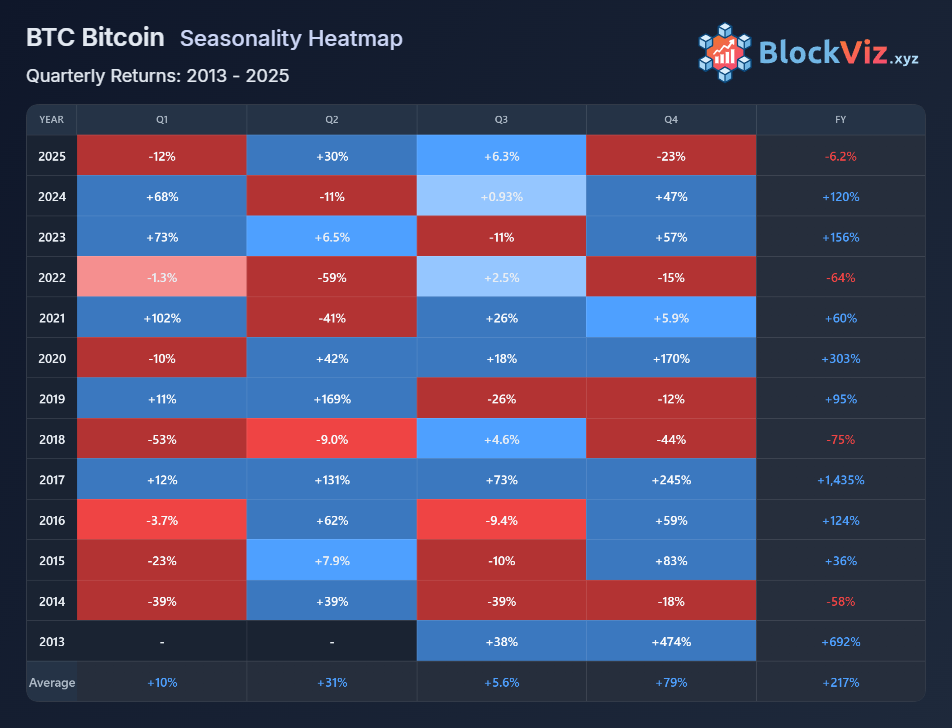
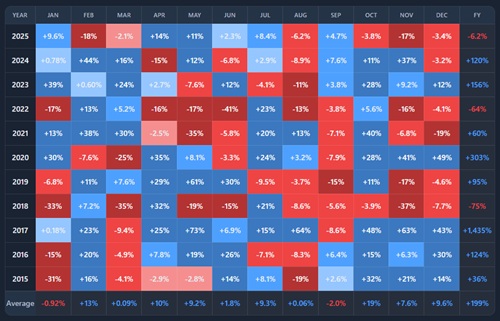
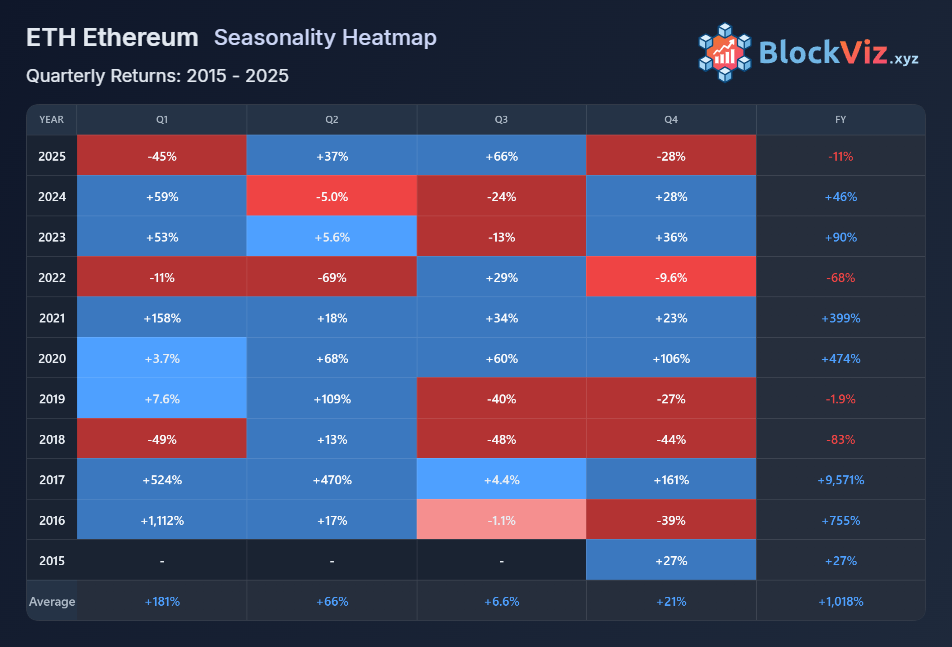
Using long-term BTC and ETH seasonality heatmaps, both monthly and quarterly, a clearer picture emerges: crypto does exhibit seasonal tendencies, but those tendencies are highly conditional on market regime and cycle position.

What the Data Actually Shows

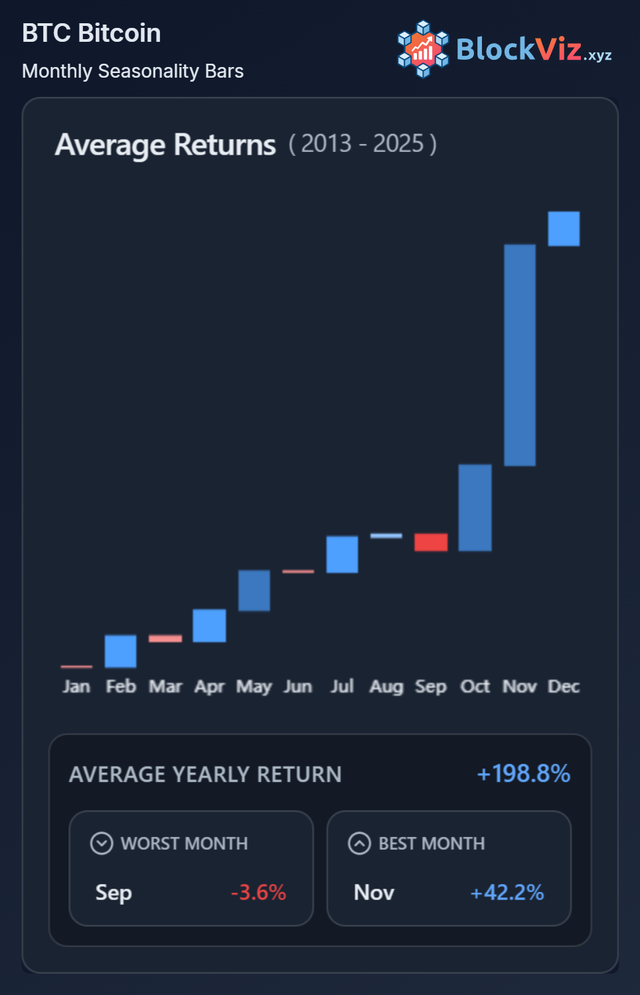
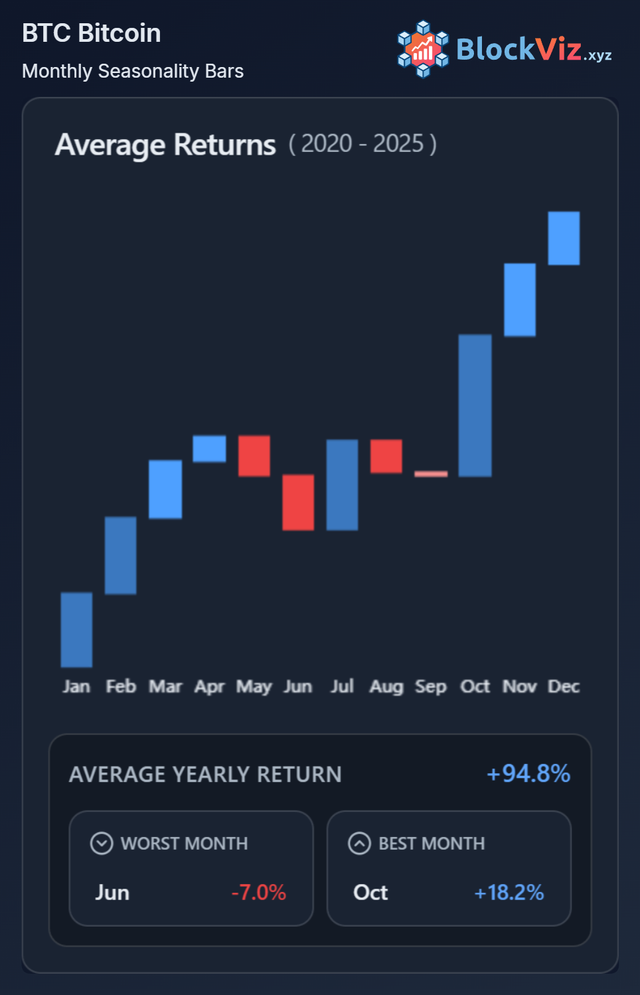
When you aggregate returns by month or quarter across many years, patterns do appear.
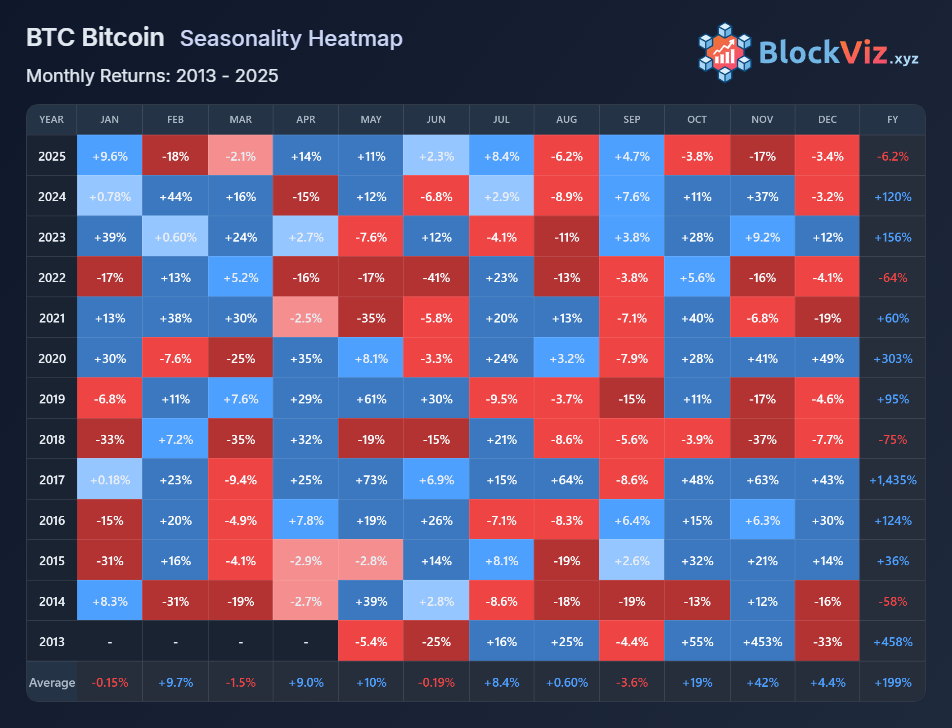
For Bitcoin:

  • Q4 has historically delivered the strongest average returns.
  • November and December stand out across multiple bull cycles.
  • Q2 tends to be more mixed, with frequent drawdowns in late-cycle or bear phases.
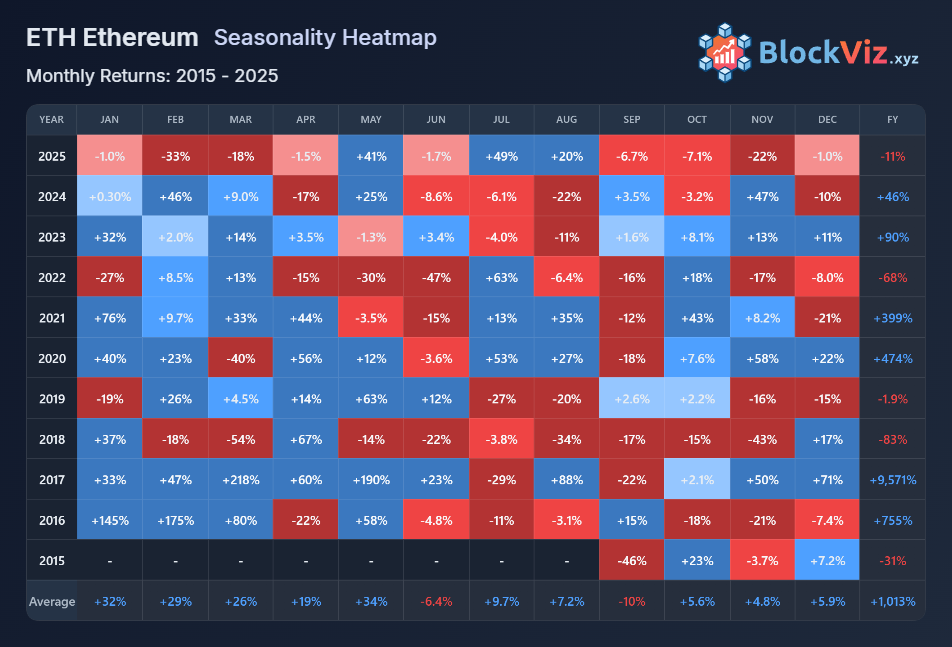

For Ethereum:

  • Returns are more volatile, but the same broad structure appears.
  • Explosive Q4 performance clusters in specific years rather than evenly across time.
  • Weakness is often concentrated mid-year during risk-off phases.

The key point is this: seasonality exists in the data, but it is unevenly distributed across years. The heatmaps make this obvious. Strong months cluster together. Weak months cluster together. This is not how classical seasonality behaves in mature asset classes.

Which leads to the real driver.

Seasonality vs the 4-Year Crypto Cycle

Most of what people call “crypto seasonality” is actually cycle-conditioned behavior.

The 4-year cycle, anchored loosely around Bitcoin halvings and liquidity expansion, dominates return distributions. It creates long regimes of accumulation, expansion, speculation, and contraction.

Seasonality does not override this cycle. It is filtered through it.

  • In post-halving expansion years, seasonal strength becomes amplified.
  • In late bull or bear years, the same calendar months often underperform or reverse.
  • Averaging across all years blends fundamentally different regimes into a single number.

This is why statements like “Q4 is bullish” feel true but fail as standalone rules. Q4 is bullish in expansionary phases, not universally.

Crypto winter and crypto summer are useful metaphors, but they describe cycle phases, not calendar certainty.

Why Seasonal Averages Can Be Misleading

Seasonal averages hide three structural realities of crypto markets:

  1. Returns are extremely concentrated A small number of months and quarters drive the majority of multi-year performance. This is visible in both BTC and ETH heatmaps, where a handful of periods dominate cumulative returns.
  2. Regime dependency matters more than the calendar The same month behaves very differently depending on whether liquidity is expanding or contracting.
  3. Volatility distorts intuition High volatility amplifies both upside and downside, making coincidental alignment with calendar periods look like causation.

Seasonality without regime awareness becomes narrative fitting.

What Seasonality Is Actually Useful For

Seasonality is not a timing signal. It is a contextual lens.

Used correctly, it helps with:

  • Setting expectations around volatility and dispersion
  • Understanding why certain months feel emotionally harder to hold through
  • Stress-testing narratives like “this always happens in X month”
  • Comparing different assets across similar calendar windows

Used incorrectly, it leads to overconfident positioning and fragile strategies.

A Practical Framework

A more robust way to think about crypto seasonality is hierarchical:

  1. Cycle first Where are we in the broader expansion or contraction cycle?
  2. Regime second Is liquidity tightening or loosening? Is risk appetite rising or falling?
  3. Seasonality last Within this regime, how have calendar periods tended to behave historically?

When seasonality aligns with cycle direction, it can reinforce trends. When it conflicts, it usually loses.

Key Takeaways

  • Crypto does exhibit seasonal patterns, visible in long-term monthly and quarterly return data.
  • These patterns are not stable across time and are heavily conditioned by the 4-year cycle.
  • What looks like seasonality is often cyclicality expressed through the calendar.
  • Seasonal averages are descriptive, not predictive.
  • The real value lies in understanding context, not chasing dates.

Seasonality exists in crypto. Just not as a rulebook.

Seasonality Heatmap preview

Explore this related tool

Seasonality Heatmap

Use the interactive tool to explore the same concept with your own time range and settings.