
BlockViz
WikiStrategy & TradingTrailing Stop vs Fixed Stop

Trailing Stop vs Fixed Stop

Category: Strategy & Trading

Stop losses are risk-management tools, not prediction tools.

The two most common types — fixed stops and trailing stops — encode very different assumptions about volatility, trend persistence, and risk tolerance. Understanding their differences matters more than choosing one over the other.

What a stop loss represents

A stop loss defines where a trade is exited when price moves against you.

It answers:

  • How much downside am I willing to tolerate?
  • When do I accept that the thesis is invalid or overstretched?

Stops control path risk, not outcomes.

What a fixed stop is

A fixed stop is set at a constant distance from the entry price.

Characteristics:

  • does not move once placed
  • defines maximum loss upfront
  • simple and predictable
  • insensitive to subsequent price action

Example:

  • Entry at $100
  • Fixed stop at −20% → $80

What a trailing stop is

A trailing stop moves up (or down) as price makes new favorable extremes.

Characteristics:

  • locks in gains as price rises
  • adapts to trend progression
  • never moves against the position
  • sensitive to pullbacks

Example:

  • Entry at $100
  • Trailing stop at −20%
  • If price rises to $150, stop moves to $120

Core difference between fixed and trailing stops

The difference is what they protect.

  • Fixed stops protect capital
  • Trailing stops protect profits

As a result:

  • fixed stops prioritize loss limitation
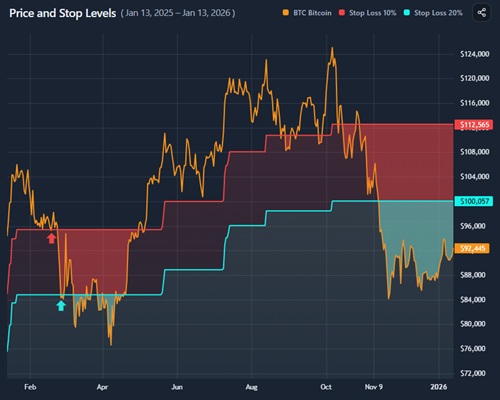
  • trailing stops prioritize gain preservation

Neither guarantees better performance.

Fixed stops in volatile markets

In high-volatility environments:

  • fixed stops are often hit early
  • exits may occur before trend resolution
  • drawdowns are capped, but participation is reduced

Fixed stops assume:

“If price moves this far against me, the trade is invalid.”

Trailing stops in volatile markets

In high-volatility environments:

  • trailing stops trigger frequently
  • profitable trends can be exited prematurely
  • gains are protected, but upside is truncated

Trailing stops assume:

“If momentum weakens meaningfully, I want out.”

In strong trends:

  • fixed stops often survive early noise
  • trailing stops progressively tighten exposure
  • trailing stops eventually exit even valid trends

Trailing stops trade participation for realized gains.

Drawdown control vs opportunity cost

Stops reshape drawdowns — they don’t remove them.

  • fixed stops cap maximum loss but increase missed upside
  • trailing stops reduce giveback but increase early exits

Opportunity cost is the hidden variable.

Common misconceptions

“Trailing stops are superior because they lock in gains”

Not always.

They can exit trends long before they are exhausted.

“Fixed stops are safer”

Not necessarily.

They may exit valid trades during normal volatility.

“Wider stops are always better”

False.

Wider stops increase tolerance — not correctness.

Choosing between fixed and trailing stops

The choice depends on:

  • volatility of the asset
  • timeframe
  • tolerance for drawdowns
  • willingness to re-enter
  • goal (risk reduction vs participation)

There is no universally optimal stop type.

When fixed stops make more sense

Fixed stops are often preferred when:

  • defining strict risk limits
  • trading mean-reversion setups
  • volatility is stable
  • exits should be decisive

When trailing stops make more sense

Trailing stops are often preferred when:

  • trends are strong
  • upside capture matters
  • drawdown control is secondary
  • participation is flexible

Key takeaway

Fixed stops and trailing stops encode different philosophies.

  • Fixed stops define risk upfront
  • Trailing stops adapt to price movement
  • Both reduce some risks while increasing others
  • Neither eliminates uncertainty

Stops manage exposure — they don’t create edge.

Stop Loss preview

Related Tool

Stop Loss

Use the interactive tool to explore the same concept with your own time range and settings.