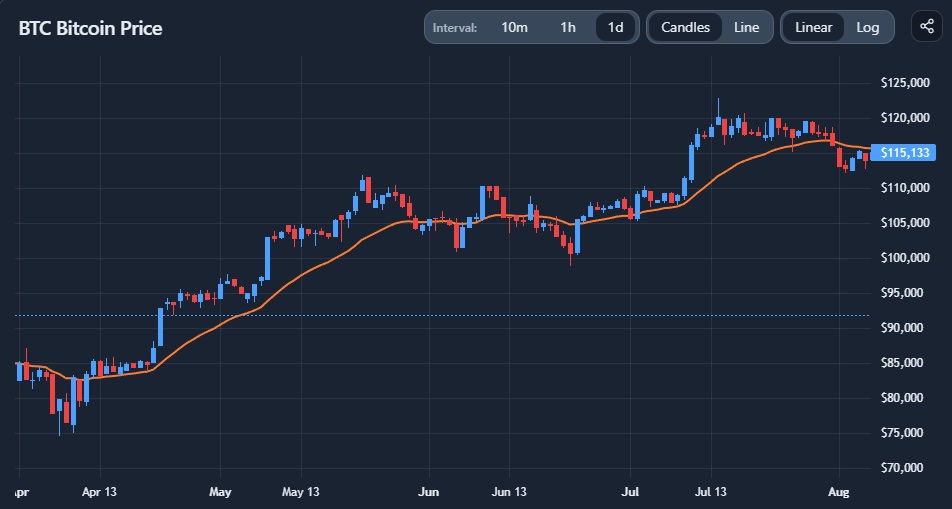
Simple Moving Averages (SMA) and Exponential Moving Averages (EMA) are two of the most widely used indicators in technical analysis.
They both smooth price data to reveal trend — but they do so in fundamentally different ways, which leads to different behavior, strengths, and weaknesses.
What a moving average represents
A moving average is a smoothed representation of price.
It answers:
- Where has price been trading on average?
- Is price above or below recent consensus?
- Is momentum accelerating or decelerating?
Moving averages are descriptive, not predictive.
What SMA is
The Simple Moving Average (SMA) is the arithmetic mean of price over a fixed number of periods.
All data points are weighted equally.
Example:
- 20-day SMA = average of the last 20 daily closes
Characteristics:
- smooth
- stable
- slower to react to price changes
- less sensitive to short-term noise
What EMA is
The Exponential Moving Average (EMA) applies greater weight to recent prices.
Recent data influences the average more than older data.
Characteristics:
- reacts faster to price changes
- follows momentum more closely
- more responsive during trend changes
- more sensitive to noise
Key difference between SMA and EMA
The core difference is weighting.
- SMA treats all periods equally
- EMA prioritizes recent price action
As a result:
- EMA turns sooner
- SMA lags more but filters noise better
Neither is objectively better — they serve different purposes.
SMA vs EMA in trending markets
In strong trends:
- EMA stays closer to price
- EMA signals changes earlier
- SMA provides a smoother trend anchor
Traders often prefer EMA when:
- trends are fast
- momentum shifts matter
SMA vs EMA in sideways markets
In range-bound markets:
- EMA generates more false reactions
- SMA avoids frequent whipsaws
- SMA is more stable as a reference level
SMA tends to perform better when markets lack direction.
Lag, noise, and trade-offs
All moving averages lag price — this is unavoidable.
The trade-off is:
- Less lag → more noise (EMA)
- More lag → less noise (SMA)
Choosing SMA vs EMA is a choice about what kind of error you prefer, not which is “right”.
Common misconceptions
“EMA is always better because it’s faster”
False.
Faster reaction increases sensitivity to noise and false signals.
“SMA is outdated”
False.
SMA is still widely used for:
- long-term trend context
- widely watched levels (e.g. 200-day SMA)
- structural market reference points
“Crossovers predict price moves”
Misleading.
Crossovers describe what already happened, not what will happen next.
How to use SMA and EMA together
Many analysts use both:
- EMA for short-term momentum
- SMA for longer-term structure
This allows:
- faster reaction without losing context
- differentiation between noise and regime shifts
When SMA is more useful
SMA is more useful when:
- analyzing long-term trends
- filtering noise
- identifying structural support/resistance
- comparing across assets or timeframes
When EMA is more useful
EMA is more useful when:
- tracking momentum
- identifying early trend changes
- working on shorter timeframes
- markets move quickly
Key takeaway
SMA and EMA smooth price in different ways.
- SMA emphasizes stability and structure
- EMA emphasizes responsiveness and momentum
- Both lag price by design
- Neither predicts — both contextualize
Understanding their differences matters more than choosing one over the other.