Seasonality describes recurring patterns in returns tied to the calendar—such as months, quarters, or parts of the year.
In crypto, seasonality is widely discussed and frequently misunderstood. While some calendar effects appear in historical data, they are weaker, less stable, and more regime-dependent than many narratives suggest.
This article explains what seasonality is, why it appears, and how to interpret it without turning it into a false timing rule.
What seasonality represents
Seasonality measures average performance by calendar period.
Common questions seasonality tries to answer:
- Are some months usually stronger than others?
- Do certain quarters tend to outperform?
- Is there a recurring yearly rhythm in returns?
Seasonality is descriptive, not predictive.
Why seasonality might exist
Seasonal effects can arise from structural behaviors such as:
- capital allocation cycles
- tax-related flows
- macro calendar effects
- behavioral anchoring
- market participation rhythms
In traditional markets, these forces are relatively stable.
In crypto, they are far less so.
Bitcoin seasonality vs altcoin seasonality
Bitcoin seasonality is often more visible because:
- Bitcoin has longer history
- liquidity is deeper
- participation is broader
Altcoin seasonality:
- is shorter-lived
- varies strongly by cycle
- often disappears when regimes change
Seasonality does not generalize well across assets.
Seasonality vs regime dependence
Seasonality only exists within a regime.
A bullish macro environment can make:
- many months look “strong”
A bearish environment can make:
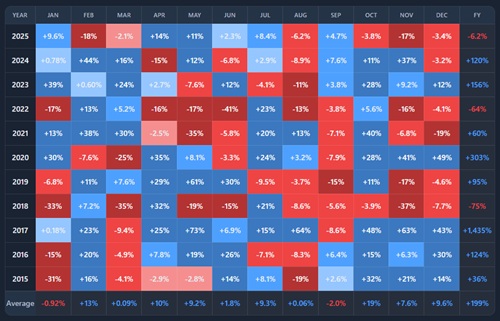
- historically strong months underperform
This is why:
- the same month can be bullish in one cycle
- and deeply negative in another
Regime dominates calendar effects.
Average returns vs distribution
Seasonality charts typically show average returns.
This hides important details:
- dispersion across years
- outlier-driven averages
- skewed distributions
A positive average month can still be:
- negative more often than positive
- driven by a few extreme years
Understanding distribution matters more than the average.
Why seasonality often breaks down
Seasonality weakens when:
- markets mature
- participants adapt
- narratives change
- macro conditions dominate
Once a seasonal pattern becomes widely known, it often loses edge.
Seasonality and narrative bias
Seasonality often reinforces narratives:
- “This is a strong month”
- “This quarter is usually bullish”
These narratives can:
- influence behavior
- amplify short-term moves
- but also create crowded expectations
Narratives do not equal structural edges.
How to use seasonality responsibly
Seasonality is best used as:
- context
- sanity check
- exploratory lens
It is most useful when:
- combined with regime analysis
- compared across many years
- evaluated alongside volatility
Seasonality should never be used in isolation.
Common misconceptions
“Seasonality predicts future returns”
False.
Seasonality explains historical averages, not future outcomes.
“If a month is usually positive, it’s safe”
False.
Drawdowns occur in all months.
“Seasonality applies uniformly across assets”
False.
Different assets exhibit different—and unstable—patterns.
When seasonality analysis is most useful
Seasonality analysis is most useful when:
- exploring long-term tendencies
- comparing periods across years
- contextualizing performance
- questioning calendar-based narratives
When seasonality analysis misleads
Seasonality misleads when:
- used as a timing rule
- detached from market regime
- reduced to single-month conclusions
- ignored in volatile environments
Key takeaway
Seasonality describes what tended to happen, not what must happen.
- Patterns exist—but are unstable
- Regime matters more than calendar
- Averages hide dispersion
- Seasonality is context, not strategy
Used correctly, seasonality helps frame expectations — not forecast markets.
