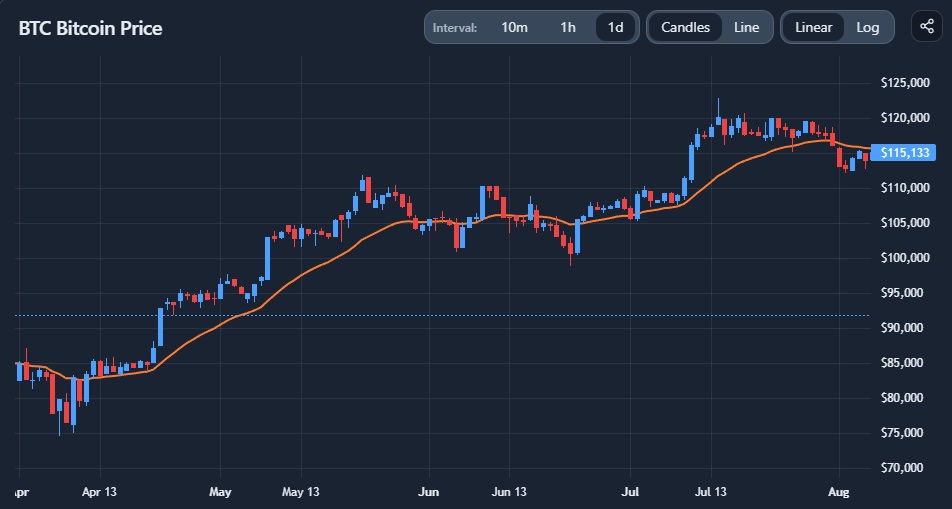
The Relative Strength Index (RSI) is a momentum oscillator that measures the speed and persistence of recent price movements.
Rather than predicting direction, RSI helps contextualize momentum strength, exhaustion, and regime shifts in price behavior.
What RSI represents
RSI compares the magnitude of recent gains to recent losses over a defined period.
It oscillates between 0 and 100.
Conceptually, RSI answers:
- How aggressively has price been moving?
- Is momentum accelerating or fading?
- Is price behavior stretched relative to recent history?
RSI measures momentum balance, not valuation.
How RSI is calculated (conceptually)
RSI is based on:
- average gains over a lookback window
- average losses over the same window
When gains dominate, RSI rises.
When losses dominate, RSI falls.
The standard lookback period is 14 periods, but this is a convention, not a rule.
Common RSI reference levels
The most widely used reference levels are:
- 70 — strong momentum / potential exhaustion
- 30 — weak momentum / potential exhaustion
These are contextual zones, not automatic signals.
In strong trends:
- RSI can remain above 70 for extended periods
- RSI can remain below 30 during sustained downtrends
RSI in trending markets
In trending environments:
- RSI shifts into higher or lower ranges
- Pullbacks often stop near 40–50 in uptrends
- Rallies often stall near 50–60 in downtrends
This is known as RSI range behavior.
Trend-aware RSI analysis focuses on:
- where RSI finds support
- whether momentum resets or breaks
RSI in sideways markets
In range-bound markets:
- RSI oscillates between 30 and 70
- Extremes occur more frequently
- Mean-reversion behavior dominates
RSI is most intuitive in non-trending environments.
RSI divergence explained
RSI divergence compares price action to momentum behavior.
- Bullish divergence
Price makes lower lows, RSI makes higher lows - Bearish divergence
Price makes higher highs, RSI makes lower highs
Divergence suggests momentum decoupling, not immediate reversal.
It works best when combined with:
- structure
- trend context
- support/resistance
RSI vs overbought / oversold myths
“Overbought” does not mean “must fall”.
“Oversold” does not mean “must rise”.
RSI extremes indicate:
- strong momentum
- potential exhaustion
- elevated sensitivity to reversals
They do not guarantee direction.
RSI vs relative performance
Despite its name, RSI does not measure relative performance between assets.
It measures:
- internal momentum of a single asset
- not outperformance vs another asset
Relative performance requires comparative frameworks, not oscillators.
Common misconceptions
“RSI above 70 means sell”
False.
In strong trends, RSI >70 often confirms strength.
“RSI works best alone”
False.
RSI is most effective when combined with:
- trend analysis
- structure
- volatility context
“RSI predicts reversals”
Misleading.
RSI highlights conditions, not outcomes.
When RSI is most useful
RSI is most useful when:
- identifying momentum regimes
- contextualizing pullbacks
- spotting momentum exhaustion
- comparing behavior across timeframes
When RSI is misleading
RSI breaks down when:
- used mechanically
- detached from trend context
- applied identically across assets
- treated as a timing oracle
Key takeaway
RSI measures how price is moving, not where it will go.
- It reflects momentum balance
- It adapts to trend regimes
- Extremes indicate strength or stress, not certainty
- Context matters more than thresholds
Used correctly, RSI sharpens intuition about momentum — not predictions.