
The Moving Average Convergence / Divergence (MACD) is a momentum indicator that describes the relationship between short-term and long-term trend components.
Rather than forecasting price, MACD helps visualize momentum shifts, trend acceleration, and deceleration.
What MACD represents
MACD measures the distance between two moving averages of price.
It answers:
- Is short-term momentum strengthening or weakening relative to longer-term trend?
- Is momentum accelerating or fading?
MACD is a rate-of-change indicator, not a directional predictor.
How MACD is constructed (conceptually)
MACD consists of three elements:
- MACD line
Difference between a fast EMA and a slow EMA - Signal line
EMA of the MACD line - Histogram
Difference between the MACD line and the signal line
The standard parameters (12, 26, 9) are conventions, not rules.
Reading the MACD line
The MACD line reflects relative momentum.
- Above zero → short-term trend is stronger than long-term trend
- Below zero → short-term trend is weaker than long-term trend
The zero line often acts as a trend regime boundary.
Understanding the histogram
The histogram shows the rate of change in momentum.
- Expanding bars → momentum accelerating
- Contracting bars → momentum decelerating
- Color or direction change → momentum shift
Histogram contraction often precedes trend pauses or transitions.
MACD crossovers in context
Crossovers describe when momentum shifts relative to its recent average.
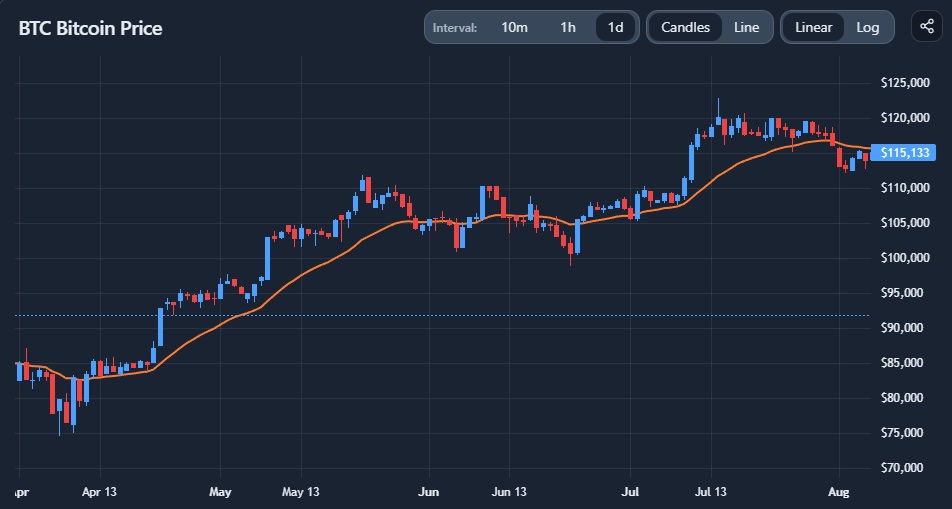
- MACD crossing above signal → momentum improving
- MACD crossing below signal → momentum weakening
Crossovers are descriptive events, not guarantees.
Their usefulness depends heavily on:
- trend context
- volatility
- timeframe
MACD in trending markets
In strong trends:
- MACD often stays above (or below) zero
- pullbacks show as histogram contractions
- zero-line tests matter more than crossovers
MACD is most informative when used to confirm trend health, not to call tops or bottoms.
MACD in range-bound markets
In sideways markets:
- MACD crosses frequently
- histogram flips often
- false signals increase
MACD loses reliability when trend structure is absent.
MACD divergence explained
MACD divergence compares price movement to momentum behavior.
- Bullish divergence
Lower price lows with higher MACD lows - Bearish divergence
Higher price highs with lower MACD highs
Divergence suggests momentum exhaustion, not immediate reversal.
MACD vs RSI
Although both measure momentum:
- RSI measures internal balance of gains vs losses
- MACD measures relative trend momentum
RSI is bounded (0–100).
MACD is unbounded and trend-relative.
They complement rather than replace each other.
Common misconceptions
“MACD crossovers are trading signals”
Incomplete.
Crossovers reflect momentum changes, not future direction.
“MACD predicts reversals”
Misleading.
MACD highlights weakening or strengthening, not certainty.
“MACD works the same in all markets”
False.
Its effectiveness depends on trend clarity and volatility regime.
When MACD is most useful
MACD is most useful when:
- confirming trend direction
- identifying momentum shifts
- contextualizing pullbacks
- analyzing regime changes
When MACD is misleading
MACD becomes misleading when:
- used mechanically
- applied in choppy markets
- interpreted without structure
- relied on for precise timing
Key takeaway
MACD visualizes how momentum evolves relative to trend.
- It shows acceleration and deceleration
- It reacts to trend shifts, not noise
- It lags price by design
- Context matters more than signals
Used properly, MACD clarifies momentum dynamics — it does not predict outcomes.
