Price is the most visible number in crypto — and the most misleading.
Market capitalization explains what a network is actually worth, while price only tells you what one unit costs. Confusing the two leads to flawed comparisons, bad intuitions, and incorrect expectations.
This article explains the difference and why price alone does not measure size, value, or upside.
What price represents
Price is the cost of one unit of an asset.
It answers:
- How much does a single coin or token trade for?
- What is the marginal price at which buyers and sellers meet?
Price does not tell you:
- how large the network is
- how much capital is invested overall
- how the asset compares in size to others
A $1 token can be larger than a $10,000 token.
What market cap represents
Market capitalization is defined as:
Market Cap = Price × Circulating Supply
It represents the total market value of all circulating units.
Market cap answers:
- How large is this asset relative to others?
- How much capital is implied at current prices?
- How much money would be required to double the valuation?
Market cap is a size metric, not a performance metric.
Why price alone is misleading
Price ignores supply.
Two assets can have vastly different prices but similar market caps:
- Asset A: $100 price × 1 million supply = $100M market cap
- Asset B: $1 price × 100 million supply = $100M market cap
They are equally sized networks, despite radically different prices.
This is why:
- “cheap coins” are not automatically undervalued
- “expensive coins” are not necessarily overvalued
Price without supply context is meaningless for comparison.
Common misconceptions about price
“This coin is cheap, so it has more upside”
False.
Upside depends on market cap growth, not unit price.
A low-priced asset can already be large, and a high-priced asset can still be small.
“If it reaches Bitcoin’s price, I’ll be rich”
This ignores supply.
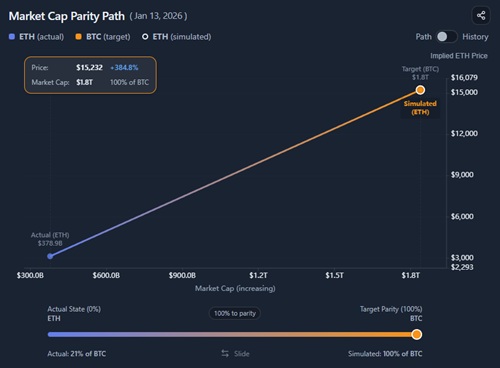
For an asset to reach Bitcoin’s price per unit, its market cap would often need to exceed the entire crypto market many times over — which is mathematically unrealistic.
“Price tells me how big the project is”
It doesn’t.
Market cap tells you size. Price tells you denomination.
Market cap and upside potential
Market cap helps frame realistic expectations.
Questions market cap answers:
- How large is this asset already?
- How much capital inflow would be required to reach a target valuation?
- Is a 10× move plausible, or would it require trillions in new value?
Price alone cannot answer these.
Market cap vs price in comparisons
When comparing assets:
- Price compares units
- Market cap compares networks
This is why:
- dominance is based on market cap
- parity simulations use market cap
- relative performance frameworks rely on market cap context
Price is local. Market cap is structural.
Why both still matter
Market cap explains scale.
Price explains trade execution.
You need price to:
- buy or sell
- measure returns
- manage entries and exits
You need market cap to:
- compare assets fairly
- reason about growth limits
- understand market structure
They answer different questions and should never be substituted for each other.
When to focus on price
Price is most useful when:
- trading short-term
- managing risk levels
- evaluating volatility
- executing strategies
When to focus on market cap
Market cap is most useful when:
- comparing assets
- thinking in narratives and cycles
- assessing upside/downside asymmetry
- analyzing dominance and rotation
Key takeaway
Price tells you what one unit costs.
Market cap tells you how big the asset really is.
- Price without supply is misleading
- Market cap provides structural context
- Upside is constrained by market cap, not price
- Smart analysis uses both — deliberately and separately
Understanding this distinction is foundational to making sense of crypto markets.