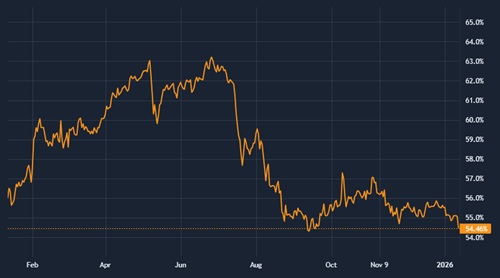
Market cap dominance measures how much of a chosen market an asset represents.
It generalizes the idea behind Bitcoin dominance and applies it to any asset, category, or custom basket.
Instead of asking:
How dominant is Bitcoin within crypto?
Market cap dominance asks:
How dominant is this asset relative to the market I care about?
What market cap dominance represents
Market cap dominance is defined as:
Asset market cap ÷ reference market cap
The key difference from Bitcoin dominance is the reference frame.
The reference market can be:
- the total crypto market
- a category (e.g. Layer 1s, Memecoins)
- a custom basket (watchlist or portfolio)
- any defined subset of assets
Dominance is always relative and context-dependent.
Why market cap dominance matters
Market cap dominance reveals relative importance, not absolute size.
It helps answer questions like:
- Is this asset gaining relevance within its sector?
- Is capital concentrating or dispersing?
- Who is leading within a specific market slice?
Dominance abstracts away price levels and focuses on share of value, which often reflects positioning and capital flows more clearly than price alone.
Reference frames and why they matter
Dominance only makes sense relative to what you compare against.
Examples:
- An asset can lose dominance in the total market but gain dominance within its category.
- A coin can outperform peers while still underperforming the broader market.
- Portfolio dominance can change even if all assets are rising.
Changing the reference frame changes the question being answered.
Interpreting rising vs falling dominance
Rising dominance
Indicates:
- increasing relative strength
- capital concentrating into the asset
- leadership within the chosen basket
Rising dominance does not require price appreciation—only outperformance relative to peers.
Falling dominance
Indicates:
- relative underperformance
- capital rotating elsewhere
- dilution from faster-growing peers
Falling dominance can happen even during strong price trends if other assets are rising faster.
Dominance vs price performance
Dominance and price measure different things.
- Price answers: Is this asset going up or down?
- Dominance answers: Is this asset gaining or losing share?
You can have:
- rising price + falling dominance (asset rising, but lagging peers)
- falling price + rising dominance (asset falling less than peers)
This distinction is critical when analyzing relative strength.
Market dominance and rotation dynamics
Dominance is particularly useful for spotting rotation.
Rotation often appears as:
- declining dominance in one asset or category
- rising dominance in another
- before absolute price trends fully reflect the shift
Because dominance focuses on share, it often highlights leadership changes earlier than price charts.
Dominance across categories and baskets
Applying dominance to categories or custom baskets allows:
- sector leadership analysis
- portfolio concentration tracking
- custom benchmarks tailored to your strategy
For example:
- dominance of a Layer 2 within all Layer 2s
- dominance of a memecoin within a memecoin basket
- dominance of a single position within a portfolio
This makes dominance a flexible framework, not a single metric.
Limitations and common misconceptions
Market cap dominance has important caveats:
- it depends on how the reference basket is defined
- new asset issuance can dilute dominance mechanically
- dominance does not capture liquidity or fundamentals
Common misconceptions:
- treating dominance as a timing indicator
- ignoring the reference frame
- assuming dominance predicts future returns
Dominance explains distribution, not direction.
When to use market cap dominance
Market cap dominance is most useful when:
- comparing assets on equal footing
- analyzing leadership and relative strength
- tracking capital concentration and dispersion
- understanding portfolio and sector structure
It is less useful for:
- short-term trading signals
- absolute valuation
- single-asset decision-making in isolation
Key takeaway
Market cap dominance is a relative lens on market structure.
- It shows who controls how much of a market
- It depends entirely on the chosen reference frame
- It complements price, not replaces it
- It shines when analyzing rotation and leadership
Used correctly, dominance helps you understand where capital is flowing, not just what is moving.