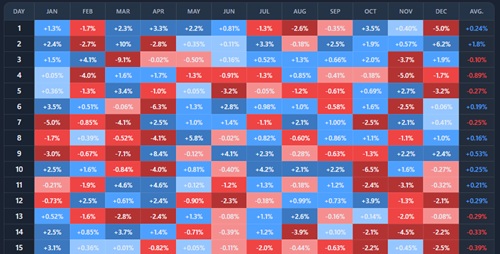
Two ways to describe the same price path — with different interpretations.
When analyzing performance, you’ll often see both geometric returns and log returns.
They are derived from the same price data, but answer different questions.
Understanding the difference helps avoid common mistakes in performance and attribution analysis.
What geometric returns represent
Geometric returns (sometimes called “normal returns”) describe actual portfolio outcomes.
They:
- reflect real-world compounding
- match how your investment value changes over time
- are what you experience as an investor
Example intuition:
- If an asset goes up 50% and then down 50%,
the geometric return is −25%, not 0%.
This asymmetry exists because losses and gains compound differently.
Use geometric returns to answer:
“What was my actual return?”
What log returns represent
Log returns transform price changes so that returns become additive over time.
They:
- allow returns to be summed across periods
- treat gains and losses symmetrically
- simplify contribution and decomposition analysis
- are commonly used in risk modeling and academic finance
In log space:
- a +10% move and a −10% move offset more cleanly
- return contributions can be added without compounding distortions
Use log returns to answer:
“How much did each period contribute to the total move?”
Why log returns are additive
Geometric returns compound multiplicatively:
- one period affects the base of the next
Log returns convert multiplication into addition:
- which makes attribution and decomposition mathematically clean
This is why log returns are often preferred for:
- contribution analysis
- volatility modeling
- comparing segments of a return path
Why portfolios experience geometric returns
Your portfolio value:
- compounds through time
- is affected by drawdowns
- cannot “add” returns linearly
This means:
- geometric returns reflect reality
- volatility reduces long-term growth (volatility drag)
- large swings matter more than averages
Even if log returns decompose neatly, your final wealth is still governed by geometric returns.
Why both perspectives are useful
Using only one return type can be misleading.
- Geometric returns show what happened
- Log returns show how it happened
When the two differ significantly:
- volatility is high
- returns are highly concentrated
- timing effects dominate outcomes
Seeing both highlights fragility that a single metric can hide.
Common misconceptions
“Log returns are more accurate”
No. They are more convenient for analysis, not more real.
“Geometric returns are wrong because they don’t add up”
They’re correct — compounding simply isn’t additive.
“You should always use one or the other”
Different questions require different lenses.
When to use each
Use geometric returns when:
- evaluating portfolio performance
- comparing investment outcomes
- communicating real gains and losses
Use log returns when:
- decomposing performance
- analyzing contribution of sub-periods
- studying volatility and risk
Key takeaway
Geometric and log returns describe the same price path from different perspectives.
- One reflects reality
- The other reveals structure
Using both avoids false confidence and incomplete conclusions.