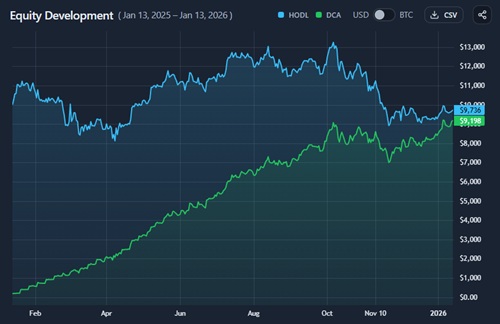
Dollar-Cost Averaging (DCA) is an investment approach where capital is deployed gradually over time instead of all at once.
Rather than trying to time the market, DCA spreads entry points across different price levels, trading timing precision for smoother exposure.
What DCA represents
DCA answers a behavioral question:
How can I reduce timing risk when entering a volatile market?
Instead of committing all capital upfront, DCA:
- divides capital into equal tranches
- invests them at regular intervals
- averages entry price over time
DCA is about process consistency, not optimization.
DCA vs lump sum investing
Lump sum (buy & hold)
- Invest all capital at once
- Maximizes exposure immediately
- Maximizes sensitivity to entry timing
- Often wins in strongly rising markets
Dollar-cost averaging
- Invests gradually
- Reduces entry timing risk
- Smooths psychological stress
- Often underperforms lump sum in strong uptrends
Neither approach is universally superior.
Why DCA works psychologically
DCA reduces:
- fear of “buying the top”
- regret from immediate drawdowns
- emotional decision-making
By committing to a rule-based process, DCA shifts focus from price to participation.
DCA in volatile markets
In volatile environments:
- DCA benefits from price swings
- average entry prices improve during drawdowns
- path dependency dominates outcomes
DCA thrives on volatility — but only when capital deployment spans meaningful fluctuations.
The cost of DCA
DCA has opportunity cost.
- capital sits idle initially
- exposure ramps slowly
- upside is delayed
In markets that trend up quickly, lump sum often outperforms.
DCA trades upside for smoother participation.
DCA interval and cadence
Common DCA cadences:
- daily
- weekly
- monthly
Shorter intervals:
- smooth price more
- reduce sensitivity to single days
- increase execution complexity
Longer intervals:
- increase timing sensitivity
- reduce operational overhead
There is no universally “best” DCA interval — only trade-offs.
DCA vs volatility regimes
DCA interacts strongly with volatility regimes:
- High volatility → DCA improves average entry
- Low volatility + strong trend → lump sum dominates
- Sideways markets → DCA and lump sum converge
Understanding regime matters more than choosing cadence.
Common misconceptions
“DCA always beats lump sum”
False.
Lump sum statistically outperforms in long-term upward markets.
“DCA removes risk”
False.
DCA reduces timing risk, not market risk.
“More frequent DCA is always better”
Not necessarily.
Higher frequency reduces variance but increases complexity and friction.
When DCA is most useful
DCA is most useful when:
- entering volatile assets
- uncertainty is high
- emotional discipline matters
- capital is deployed over time anyway
When DCA is less effective
DCA is less effective when:
- strong trends are already underway
- capital is already available
- opportunity cost dominates concern
Key takeaway
DCA is not a performance hack — it is a behavioral tool.
- It reduces timing stress
- It smooths entry prices
- It sacrifices some upside
- It improves consistency
Used correctly, DCA helps investors stay invested — which often matters more than perfect timing.