
Bollinger Bands are a volatility-based indicator that adapt to changing market conditions.
Rather than predicting direction, they help answer a different question:
Is price behaving normally, or is it stretched relative to recent volatility?
What Bollinger Bands represent
Bollinger Bands consist of three lines:
- Middle band
A moving average (typically a 20-period SMA) - Upper band
Middle band + a multiple of standard deviation - Lower band
Middle band − a multiple of standard deviation
Together, they form a dynamic price envelope that expands and contracts with volatility.
Volatility, not overbought or oversold
Bollinger Bands are often misunderstood as overbought/oversold indicators.
In reality, they reflect:
- how volatile the market is
- how far price has moved relative to recent dispersion
Price touching or exceeding a band does not imply reversal.
It implies volatility expansion.
Band expansion and contraction
Band expansion
When bands widen:
- volatility is increasing
- price movement is accelerating
- markets are transitioning into active phases
Expansion often follows periods of compression.
Band contraction (the “squeeze”)
When bands narrow:
- volatility is compressed
- price movement is subdued
- markets are coiling
Squeezes often precede large directional moves, but not their direction.
Price behavior within the bands
Price tends to:
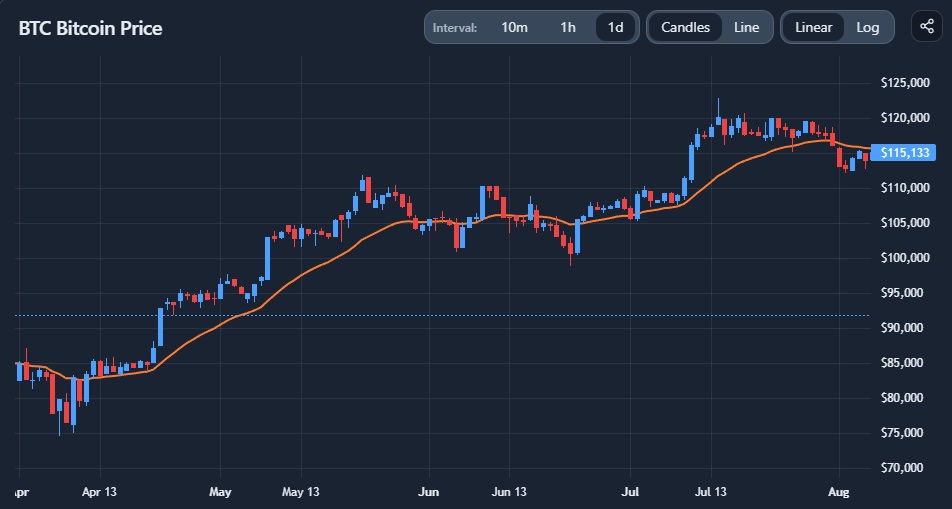
- oscillate around the middle band in ranges
- ride the upper band in strong uptrends
- ride the lower band in strong downtrends
Trend strength is often visible in how price interacts with the bands, not whether it touches them.
Bollinger Bands in trending markets
In strong trends:
- price frequently stays near one band
- pullbacks often stop near the middle band
- band touches confirm strength, not exhaustion
Using bands as reversal signals in trends leads to repeated false conclusions.
Bollinger Bands in sideways markets
In range-bound markets:
- price oscillates between bands
- band touches align better with mean reversion
- volatility stays relatively stable
Bands are more intuitive in non-trending regimes.
Bollinger Bands and volatility regimes
Bollinger Bands are most powerful when used to identify volatility regimes:
- Compression → low-volatility regime
- Expansion → high-volatility regime
- Sustained width → trending environment
They help contextualize when markets are likely to move — not where.
Common misconceptions
“Price touching the upper band means sell”
False.
In trends, upper-band touches often signal strength.
“Bollinger Bands predict breakouts”
Incomplete.
They highlight volatility conditions, not breakout direction.
“Bands work the same in all markets”
False.
Effectiveness depends on trend and volatility context.
When Bollinger Bands are most useful
Bollinger Bands are most useful when:
- identifying volatility compression and expansion
- contextualizing price moves
- distinguishing trend vs range behavior
- framing risk rather than timing entries
When Bollinger Bands are misleading
They become misleading when:
- treated as fixed overbought/oversold levels
- used without trend context
- relied on as standalone signals
- interpreted mechanically
Key takeaway
Bollinger Bands describe volatility structure, not direction.
- They adapt to market conditions
- They expand and contract with volatility
- Band touches reflect behavior, not certainty
- Context determines meaning
Used correctly, Bollinger Bands help you understand how stretched price is, not what it must do next.
