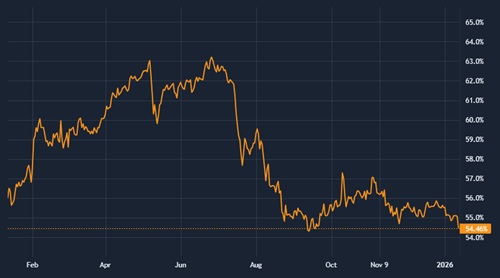
Bitcoin dominance measures Bitcoin’s share of the total crypto market capitalization.
It answers a simple but powerful question:
How much of the crypto market’s value is concentrated in Bitcoin right now?
Because Bitcoin sits at the center of crypto liquidity, sentiment, and risk perception, its dominance has become one of the most widely used indicators for understanding market regimes, capital rotation, and altcoin risk appetite.
What Bitcoin dominance represents
Bitcoin dominance is defined as:
Bitcoin market cap ÷ total crypto market cap
It is a relative metric, not a price metric.
- Bitcoin price can rise while dominance falls
- Bitcoin price can fall while dominance rises
Dominance tells you where capital is allocated, not whether prices are going up or down.
At a high level:
- Rising dominance → capital concentrating into Bitcoin
- Falling dominance → capital dispersing into altcoins
Why Bitcoin dominance matters
Bitcoin dominance matters because Bitcoin functions as:
- the reserve asset of crypto
- the primary liquidity sink
- the asset traders rotate into and out of during regime shifts
As a result, dominance often reflects risk preference more clearly than price alone.
In practice, Bitcoin dominance is used to:
- gauge whether markets are risk-on or risk-off
- understand whether altcoin strength is broad or fragile
- contextualize altcoin performance relative to Bitcoin, not fiat
How to read rising vs falling dominance
Rising Bitcoin dominance
Typically associated with:
- risk aversion
- capital fleeing smaller or speculative assets
- market stress, uncertainty, or drawdowns
This can happen:
- during market sell-offs
- during early recoveries when capital returns cautiously
- when altcoins underperform even if prices are rising overall
Rising dominance does not require Bitcoin to outperform in absolute terms—only relative to the rest of the market.
Falling Bitcoin dominance
Typically associated with:
- increasing risk appetite
- capital rotating into altcoins
- expanding breadth of market participation
This often occurs:
- during “alt seasons”
- after Bitcoin has already made a strong move
- when speculative segments attract inflows
Falling dominance signals dispersion, not necessarily sustainability.
Bitcoin dominance and market regimes
Bitcoin dominance is best understood as a regime indicator, not a trading signal.
Common regimes include:
- High & rising dominance
Defensive market, Bitcoin leadership, altcoins lag - High but falling dominance
Early rotation phase, selective altcoin strength - Low & falling dominance
Broad risk-on environment, altcoin-driven market - Low but rising dominance
Altcoin exhaustion, capital rotating back to Bitcoin
The same dominance level can mean very different things depending on trend direction and broader context.
Bitcoin dominance vs altcoin performance
A common misconception is that:
“If Bitcoin dominance falls, altcoins must be doing well.”
In reality:
- dominance can fall because altcoins rise faster
- or because Bitcoin falls faster
- or because new assets dilute the market
Dominance should always be read alongside price action, not in isolation.
Strong alt markets typically show:
- falling dominance
- and rising altcoin prices
- and improving breadth across categories
Limitations and common misconceptions
Bitcoin dominance is powerful—but imperfect.
Key limitations:
- it depends on how “total market cap” is defined
- new token issuance can mechanically reduce dominance
- stablecoins can distort dominance during stress periods
Common mistakes:
- treating dominance levels as absolute buy/sell signals
- ignoring trend direction
- ignoring changes in market structure over time
Dominance explains capital distribution, not future returns.
When Bitcoin dominance is most useful
Bitcoin dominance is especially useful when:
- comparing Bitcoin vs altcoin risk
- identifying rotation phases
- analyzing market structure beyond price
- contextualizing strong or weak altcoin performance
It is less useful for:
- short-term trading
- timing exact entries or exits
- analyzing single-asset fundamentals
Key takeaway
Bitcoin dominance is a lens on market structure, not a price forecast.
- Rising dominance reflects concentration and caution
- Falling dominance reflects dispersion and risk appetite
- Context matters more than levels
- Trends matter more than single readings
Used correctly, Bitcoin dominance helps answer where capital is flowing—which is often more important than what price is doing.